

CLINICAL STUDIES & VISIBLE RESULTS
nex-p 10+ has been evaluated through in vitro laboratory studies, appearance-based assessments, and professional-use observations.
The available data examine skin-related cell coverage, the appearance of temporary redness, skin brightness, antioxidant activity under laboratory conditions, scalp-related cell activity, and visible changes in skin texture, tone, and post-blemish appearance.
Results should be interpreted according to the specific test sample, protocol, observation period, and assessment method used in each study.

In Vitro Dermal & Epidermal Cell Migration Assessment
An in vitro Scratch Cell Migration Assay was conducted to evaluate cell migration activity under controlled laboratory conditions. Compared with the untreated control, the conditioned medium (CM) formulation demonstrated significantly greater dermal fibroblast and epidermal cell migration under the conditions of the study.
In Vitro Dermal Cell Migration: The formulation demonstrated significantly greater dermal fibroblast migration in the test model, resulting in over 50% greater measured cellular coverage within 24 hours compared with the untreated control under the conditions of the study.
In Vitro Epidermal Cell Migration: The conditioned medium (CM) formulation demonstrated enhanced epidermal cell migration in the test model, resulting in greater measured cell coverage compared with the untreated control under the conditions of the study.
Cosmetic Formula Characteristics: Formulated without artificial chemical stimulants or steroid-based ingredients, the conditioned medium (CM) formulation is designed for professional topical cosmetic application.
These findings are based on an in vitro laboratory assay and describe the performance of the test material under the conditions of the study. They do not establish clinical skin regeneration, wound healing, or therapeutic effects in humans.

Post-Procedure Redness & Skin Tone Appearance Assessment
The conditioned medium was evaluated for its effects on the visible appearance of temporary post-procedure redness and uneven skin tone following professional cosmetic procedures such as microneedling (MTS) and laser treatments.
Appearance of Temporary Redness: Clinical evaluation demonstrated an average 36% improvement in the visible appearance of temporary redness after four weeks of professional application, helping skin appear calmer and more comfortable following cosmetic procedures.
In Vitro Melanogenesis Assessment: An in vitro melanogenesis assay was conducted under controlled laboratory conditions. Compared with the untreated control, the conditioned medium demonstrated up to 72% lower measured melanin-related activity under the conditions of the study.
Comparative In Vitro Evaluation: In comparative in vitro testing, the conditioned medium demonstrated lower measured melanin-related activity than Kojic Acid and the other conditioned media formulations evaluated under the specific laboratory conditions of the study.
These findings are based on laboratory testing and describe the performance of the test material under the conditions of the study. They do not establish clinical skin-lightening, pigment-correction, or therapeutic effects in humans.

In Vitro Antioxidant Activity Assessment
Under in vitro conditions of reactive oxygen species (ROS)-induced oxidative stress, the conditioned medium demonstrated antioxidant activity compared with the untreated control under the conditions of the study.
In Vitro Cell Viability Assessment: In the laboratory model, the conditioned medium demonstrated higher measured cell viability than the untreated control under oxidative stress conditions, including at lower test concentrations.
Comparative In Vitro Evaluation: Compared with the standard antioxidant reference control (AA 50 μM), the conditioned medium demonstrated comparable or greater measured antioxidant-related activity under the specific laboratory conditions of the study.
Antioxidant-Related Formula Assessment: The antioxidant-related activity observed under laboratory conditions supports further evaluation of the conditioned medium as an ingredient for professional topical cosmetic formulations.
These findings are based on in vitro laboratory testing and describe the performance of the test material under the conditions of the study. They do not establish clinical antioxidant, cytoprotective, anti-apoptotic, or therapeutic effects in humans.

In Vitro Follicular Cell Activity Assessment
This study evaluated the effects of the conditioned medium (CM) on follicular cell activity under controlled in vitro laboratory conditions.
In Vitro Follicular Cell Activity: Under the test conditions, the conditioned medium demonstrated greater measured follicular cell activity compared with the untreated control.
Comparative In Vitro Evaluation: Cell cycle analysis demonstrated increased follicular cell activity compared with the untreated control. Results were also compared with those observed using the positive reference control under the same experimental conditions.
In Vitro 48-Hour Assessment: Within 48 hours, the conditioned medium demonstrated increased measured follicular cell activity compared with the untreated control under the conditions of the study.
These findings are based on in vitro laboratory testing and describe the performance of the test material under the conditions of the study. They do not establish clinical hair-growth, hair-loss prevention, scalp-regeneration, or therapeutic effects in humans.

Clinical Results
2-Month Advanced Wrinkle Improvement

Following a two-month professional application protocol, clinical evaluation demonstrated visible improvement in the appearance of deep neck wrinkles, skin smoothness, and overall skin texture.
Visible Improvement in Neck Wrinkles
Following four professional application sessions, the appearance of prominent neck wrinkles was visibly improved, resulting in smoother-looking skin and improved skin texture.
Visible Improvement in Facial Contours
Following six professional application sessions, the appearance of the cheeks and nasolabial area showed visible improvement, with enhanced facial contours and a more defined-looking jawline.
Improved Appearance of Skin Firmness
Clinical assessments demonstrated progressive improvement in the appearance of skin firmness and elasticity throughout the professional application period.
Visible Anti-Aging Benefits
Clinical assessments demonstrated progressive improvements in the appearance of skin smoothness, elasticity, and overall youthful-looking skin during the study period.
Anti-Pigmentation Treatment Progress

Clinical evaluation assessed changes in the visible appearance of uneven skin tone following professional cosmetic application after microneedling (MTS) procedures.
Visible Improvement in Uneven Skin Tone
Following four professional application sessions, areas of visible discoloration appeared lighter and more evenly distributed, resulting in a more uniform-looking skin tone.
Cosmetic Brightening Complex
The formulation contains a combination of Glutathione, Vitamin C, and Vitamin E, cosmetic ingredients selected to support a brighter, more radiant-looking complexion.
Overall Skin Tone Appearance
Clinical assessments demonstrated progressive improvement in the appearance of uneven skin tone and overall skin brightness throughout the professional application period.
Erythema Reduction Timeline
(Day 0 to Day 6)

Following professional cosmetic procedures, clinical observation documented progressive changes in the visible appearance of temporary redness and overall skin appearance during the six-day observation period.
Day 1 (Early Comfort & Appearance)
Following professional application, the skin appeared calmer and more comfortable, with a visible improvement in the appearance of temporary redness during the initial observation period.
Day 3–Day 6 (Visible Skin Appearance)
During the observation period, the appearance of temporary dryness, flaking, and redness progressively improved, resulting in smoother- and healthier-looking skin.
Forehead Wrinkle Appearance Assessment
Following six professional application sessions, clinical assessments demonstrated visible improvement in the appearance of forehead wrinkles and overall skin smoothness.
Post-Acne Scar & Scientific Data Verification
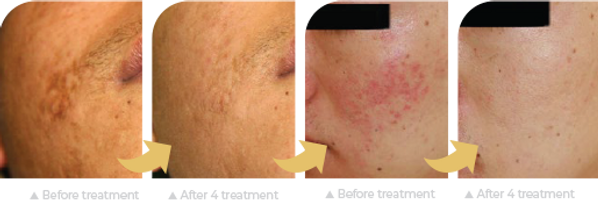
Clinical evaluation demonstrated visible improvement in the appearance of post-blemish marks and uneven skin texture following professional cosmetic application. These appearance-based changes were assessed using VISIA® skin imaging and analysis technology.
Appearance of Post-Blemish Marks & Skin Texture
Clinical assessments demonstrated visible improvement in the appearance of post-blemish marks and uneven skin texture, resulting in smoother- and more even-looking skin.
VISIA Skin Brightness Assessment
VISIA® image analysis demonstrated an increase in skin brightness, reflected by improved L* value measurements obtained under the conditions of the study.
VISIA Facial Contour Assessment
Following four weeks of professional application, VISIA® image analysis demonstrated a progressive improvement in the appearance of facial contours, with a reduction in the measured cheek sagging angle under the conditions of the study.